
Every equestrian should take lessons.
Everyone should take the time to find a trainer they trust and with whom they have appropriate chemistry.
Growing up, not unlike many, many equestrians, I rode “school horses” – off the track thoroughbreds, former trail riding quarter horse crosses, mixed breed ponies and retired showers alike. We all should ride these horses, the grumpy old guys who don’t want to keep working; the obnoxious mares who shine in the show ring and buck like the devil when you’re home; the devious pony who can always get you rubbed off and you can’t ever quite tell how. Riding these guys teaches us how to ride horses, not just how to ride a single horse. Horses, like people, come in every shape and size conceivable, with every personality type we could imagine. Part of why the college and high school riding team shows are so successful at producing quality riders is because the students get to the show, get assigned their horse, and whoever they get, they have to ride them to the best of their ability. The best piece of advice my childhood trainer gave me is, ride as many different horses as you can. Now, in my thirties, I’ve ridden well over a hundred, and lost track of the variations by breed, ages, genders, riding styles, training types, and the like.
Every riding school has horses to ride. Many have a variety of horses that will teach you to ride any horse you encounter. Not every program has a proper school master.
The school master takes the rider, who can ride lots of horses, and teaches them how to ride like the professionals do.
The best analogy I have is learning to play music. In many schools, kids have to pick a musical instrument to play, and can use a school-owned instrument, or a rental instrument, and learn the basics. Once you know the basics, though, and you can play well, you cannot hear or feel what it is to produce professional music, because the instrument is incapable of producing that quality sound. Your fingers cannot learn how to create certain nuances if the instrument cannot produce them. It is not the fault of the musician nor the instrument, but it must be recognized that at some point, if you want to continue to play music, you must leave behind the student instrument and pick up the professional level, so you can begin the process of producing music at a higher level.
It is the same, or similar in horses. A good lesson program will move you up from the beginner pony, who’s bomb proof and more whoa than go, eventually to the fresh OTTB who’s hot and spicy and can’t always get the correct lead at the canter, for example. You school and you show and move up in levels. If you are very lucky, or picky, you can move up to a school master, who can show you how to produce the nuances of professional riding.
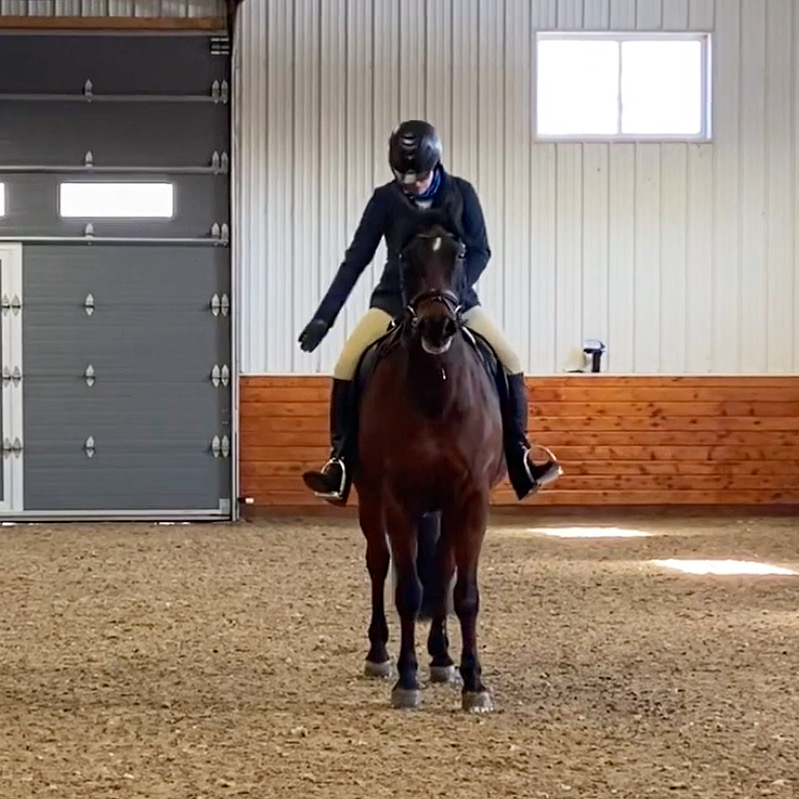
I am very lucky that my dressage trainer has two of these masters.
Both of these horses are World Champion Morgan horses.
Both of these horses had full careers in Morgan rail disciplines, and both as later teenagers quickly mastered a new discipline so thoroughly that both have USDF medals.
Riding these horses is like playing a Stradivarius. I feel I can say that, as I play the cello and once was invited by incredible chance to play a little on a visiting professional’s Strad. It is nothing like training a young horse, which is what I spend most of my time doing, or even like riding a nicely trained show horse. It is incomparable, though once settled in the saddle for the first time with each of these horses, I definitely felt as though a very good and foolish friend was allowing me to take their very expensive sports car for a joy ride.
A school master is the Stradivarius in its discipline. It is the best tool upon which to learn your chosen style to ride.
I am a new dressage student, relatively speaking, as I have only been riding dressage for a year. I have ridden for so many years, with so many people, in so many disciplines and on so many horses, that I consider myself an excellent rider. I love young horses, and as a breeder I like to start my young horses before they go out into the world so they have the best start (I can’t always, as I wait until earliest three but more often four to get on their backs, as I do not want to hinder their growth or cause them pain). I’m usually I’m a position of schooling the horse, training the horse, teaching them what to do or reminding them of what they always know. To ride the two masters in my trainer’s barn, I am finally learning what it feels like to be schooled myself. These two geldings are kind boys, not tough or ornery – but they will not do “the thing” unless I am asking for “the thing” correctly. One is slightly more forgiving, and will take a slightly miffed direction and give you the benefit of the doubt, but the other will not move towards the asked for action unless you are on the money with your cues. It forces you to be present, mentally, every single stride. It forces you to RIDE, every single stride. It makes every muscle in your body ache with the effort. When you get it, though, their reward is so happy, the action done so nicely and beautifully that it impresses on your mind and body how to ask correctly.
Every lesson should move you forward in your discipline. Every clinic, every show, and even every ride, we should be growing and learning and expanding. If you find you are not moving forward, and you want to be, it might be time to reach out, find a clinician who’ll really push you, find a new place to school, or even find a new horse to work with and learn new things. Trainers and masters are out there, who will help you reach new heights, push you to be where you want with your riding, and find you the opportunities that will best help you grow.
My hope for you is that you find your place with your horses, with people who support you, and that you all enjoy the ride.
 The Modern Morgan